|
|
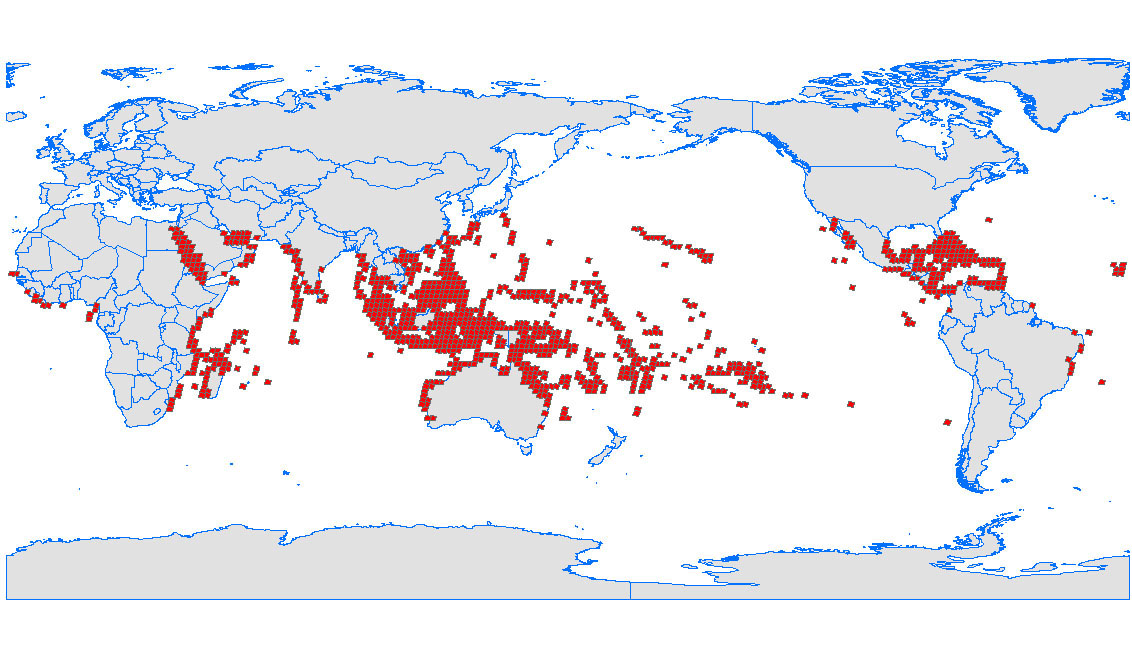
Coral ReefCoral Reef Formations | Coral Reef Biology | Hazards to Reefs | Coral Reefs Maps | Coral Reef Articles"Coral reefs are the most biodiverse of all known marine ecosystems, and maintain much higher genetic diversity than tropical rainforests. They therefore represent the world’s most significant storehouse of potential future products." (John McManus, The International Coral Reef Initiative: Partnership Building and Framework Development, report of the ICRI Workshop, Dumaguete City, The Philippines, 29 May-2 June 1995.) The term "coral reef" generally refers to a marine ecosystem in which the main organisms are corals that house algal symbionts within their tissues. These ecosystems require: 1) fully marine waters; They are therefore restricted to shallow waters of tropical and subtropical regions.
Corals that do not have algal symbionts can also form significant reef communities in deeper, darker, and colder waters, but these communities are distinguished as cold-water coral bioherms. You can find best scuba diving and snorkeling distanations at wonders of the world. The more technical definition of "coral reef" includes an additional geological requirement that the reef organisms produce enough calcium carbonate to build the physical reef structure. The coral reef community lives only on the surface veneer of the reef, on top of already existing skeletal material left behind by previous reef-builders. Many processes act to break down the skeletal material and reef as soon it is laid down by organisms. These include mechanical processes such as waves and currents, and a wide array of biological processes (e.g., bioerosion). Some of the best known bioeroders are large organisms such as parrotfish and sponges, but much of the bioerosion occurs at the microscopic scale by organisms such as algae and fungi. A coral reef is produced only if the coral reef community produces more calcium carbonate than is removed. Indeed, some coral reef communities grow too slowly to build a reef. Coral Reef FormationsCoral reefs can take a variety of forms, defined in following;
Read more about Coral Reef Formations Coral Reef Biology
Read more about Coral Reef Biology Hazards to Coral Reefs
Read more about Coral Reef Hazards Coral Reefs Maps
Indian Ocean, Red Sea and Gulf Coral Reef Maps Central and Western Pacific Coral Reef Maps These maps, from the book Coral Reefs of the World by Susan M. Wells, are posted with permission of the publishers IUCN Conservation Monitoring Center and United Nations Environment Programme(UNEP). UNEP/IUCN(1988). Coral Reefs of the World.Volume 1, Volume 2 and Volume 3: UNEP Regional Seas Directories and Bibliographies. IUCN, Gland, Switzerland and Cambridge, U.K./UNEP, Nairobi, Kenya. ISBN: 2-88032-943-4, 2-88032-944-2, 2-88032-945-0 |
|
||||||||
|
|||||||||
|
Copyright © 2015 Coral Reef Info | Privacy Policy |
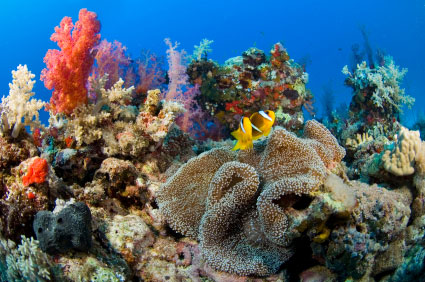
 Thousands of corals species exist worldwide. Stony (hermatypic) corals are the best recognized because of their elaborate and colorful formations. One trait of stony corals is their capacity to build reef structures that range from tens, to thousands of meters across. As they grow, reefs provide structural habitats for hundreds to thousands of different vertebrate and invertebrate species.
 Coral reefs face numerous hazards and threats. As human populations and coastal pressures increase, reef resources are more heavily exploited, and many coral habitats continue to decline. Current estimates note that 10 percent of all coral reefs are degraded beyond recovery. Thirty percent are in critical condition and may die within 10 to 20 years. Experts predict that if current pressures are allowed to continue unabated, 60 percent of the world’s coral reefs may die completely by 2050 (CRTF, 2000). Most scientists believe coral reef degradation occurs in response to both natural and anthropogenic (human-caused) stresses.
(Reference: NOAA)
Coral reefs face numerous hazards and threats. As human populations and coastal pressures increase, reef resources are more heavily exploited, and many coral habitats continue to decline. Current estimates note that 10 percent of all coral reefs are degraded beyond recovery. Thirty percent are in critical condition and may die within 10 to 20 years. Experts predict that if current pressures are allowed to continue unabated, 60 percent of the world’s coral reefs may die completely by 2050 (CRTF, 2000). Most scientists believe coral reef degradation occurs in response to both natural and anthropogenic (human-caused) stresses.
(Reference: NOAA)